Jobs at Clavey
info@clavey.eu
+49 (531) 28 600 0

Products

Flexible handling technology

What makes us special

Taking responsibility

Flexible handling technology

Do you have any questions about your Schindler manual handling system?

Then you’ve come to the right place! At Clavey, we have extensive know-how, the original system documentation – and a team that knows your machines inside out. Many of our employees have already worked for Schindler Handhabetechnik and contribute their experience directly to our services.

Whether spare parts, maintenance or technical support: we ensure that your system continues to run reliably and efficiently. Put your trust in our expertise, quality and fast service – for maximum machine availability.

Please get in touch with one of our contacts directly.

We combine many years of experience with the highest quality and reliability – for maximum availability of your machines.

Your contact persons

Technical Manager

Schwarza location

Salzgitter location

For general inquiries about our automated, patented and flexible handling technologies, please use our contact form.

Product solutions

We do that

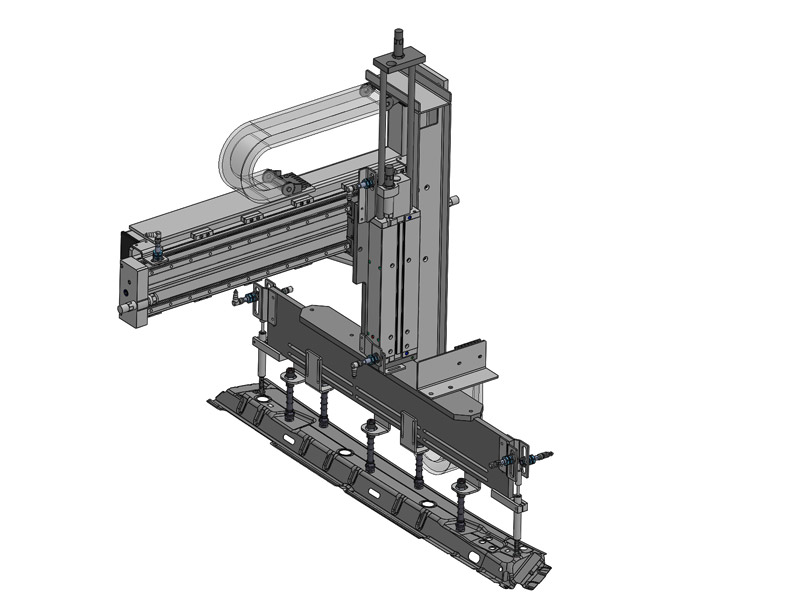
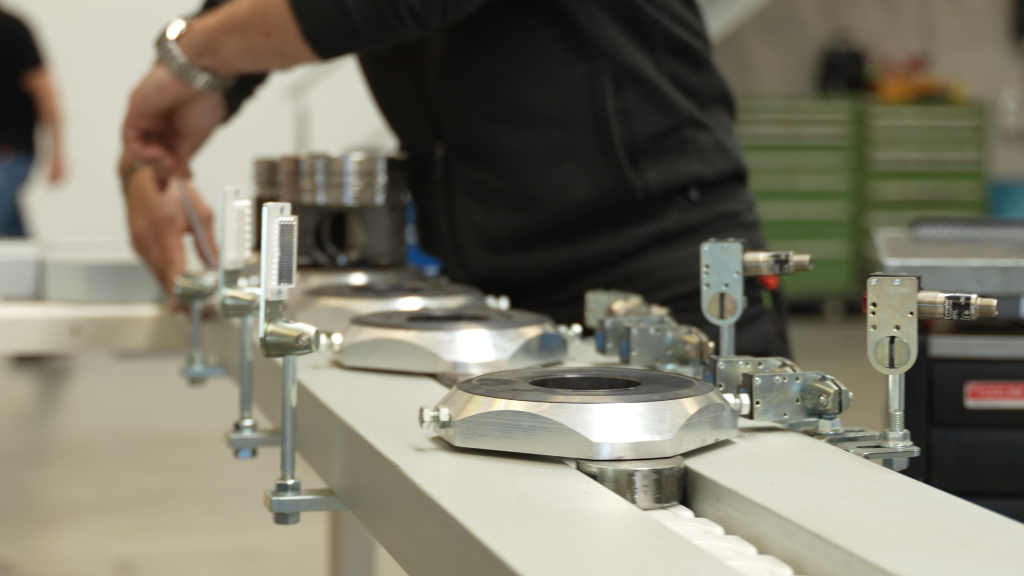
PICK&PLACE handling is a system that can be moved in 2 or 3 axes (X-axis, Y-axis and Z-axis). The system is used to transfer or insert feed parts into holders. Force-fit and/or form-fit gripping techniques are used for this purpose.

Functional sequence:

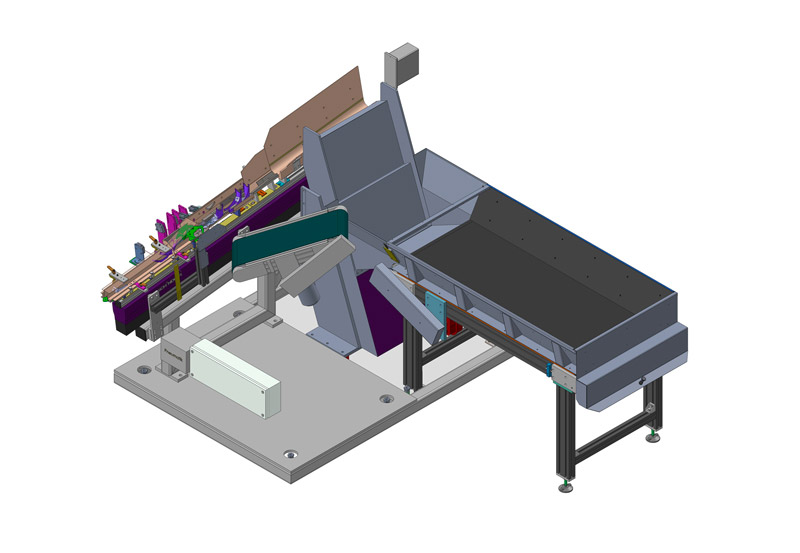
At the end of the sorting rail, the sorted parts are provided separately. The parts are picked up or gripped by the gripper on this system. They are then moved vertically upwards and to the transfer position by the PICK&PLACE handling system and deposited there.

Variants:

Our PICK&PLACE handling system can be used as a 2- or 3-axis system with pneumatic and/or servo axes. The individual strokes/travel paths are designed according to customer requirements. This system can be designed as a column or gantry handling system. The grippers are based on the customer’s requirements and are also heavily dependent on the component to be handled.

Our PICKLA allows you to reach into the box without any image monitoring and is suitable for ferritic workpieces.

Functional sequence:

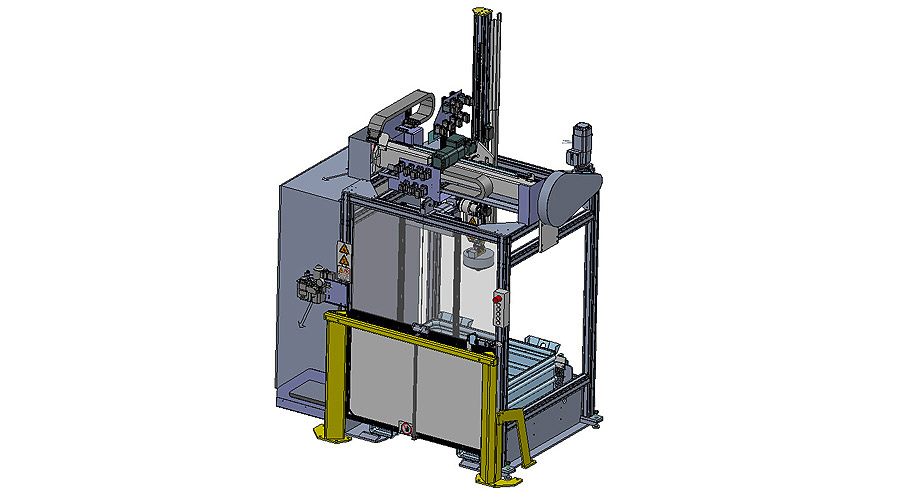
The PICKLA empties the set container fully automatically. The ferritic workpieces are removed using electromagnets. The number, shape and strength of the magnets are adjusted according to the size and shape of the workpieces. The lowering movement of the “picker arm” is stopped immediately by a freewheel function when the magnet touches down. The container is only loaded with the weight of the picker arm.

Depending on the cycle time and magnet selection, the workpieces are picked up individually or in several parts and transported to the unloading position. The PICKLA scans the entire surface of the container filling in a grid pattern. The gripped workpieces are unloaded in the unloading position of a downstream alignment system. The magnetic polarity changes during the unloading process, creating a push-off effect for the attached workpieces.

Once the PICKLA has reached the lowest position in the container on a grid point, the so-called search run begins. The next pick position is approached without unloading movement. If the entire base of the container has been moved to without success, the PICKLA moves to the home position and signals “container empty”. A pre-warning message “Bin is getting empty” after reaching the lowest pick position for the first time is also possible.

Option:

To prevent downtimes in the downstream processing machines, a double PICKLA can be used to change containers. We can also manufacture your PICKLA with a sliding door or light curtain instead of a safety door.

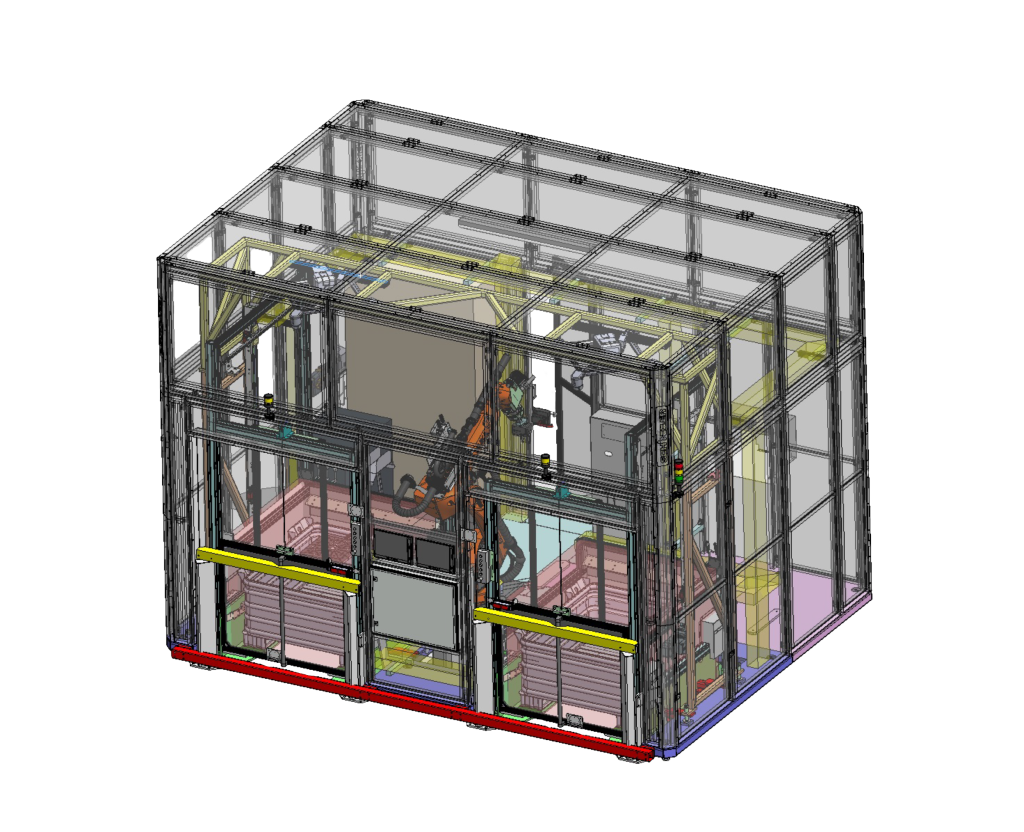
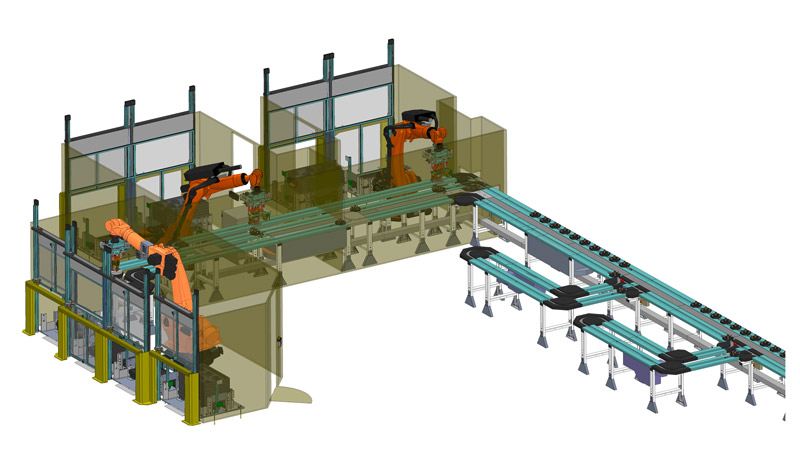
A bin-picking cell is a system in which components are removed directly from a container using a robot. The components can be placed or transferred directly into holders or processing equipment.

Functional sequence:

A camera system is used to take a picture of the contents of a container.

This image is used to define components that can be removed.

A 6-axis robot with a gripper system is controlled specifically to the component in the container and the component is gripped in a targeted manner. The robot then moves out of the container and the part can be transferred for subsequent processing.

Option:

The bin-picking cell is equipped with one bin storage location. Optionally, several bin storage locations can be installed to minimize bin change times or to provide different components with one cell.

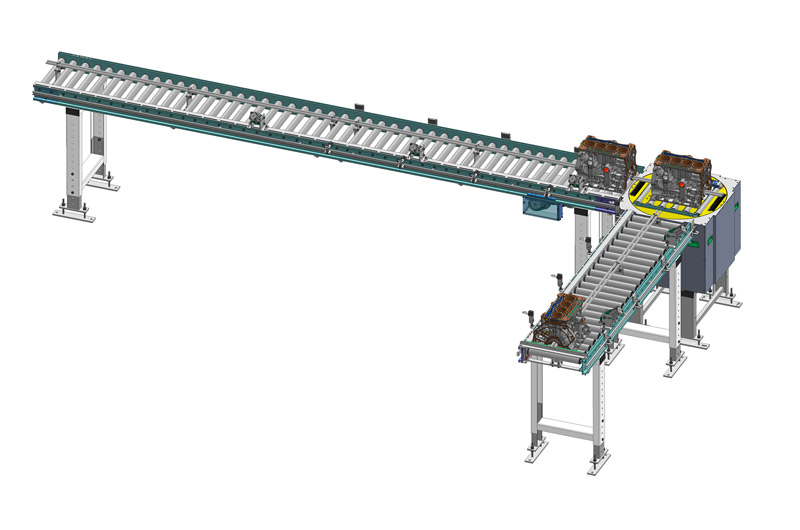
Several processing machines, which are responsible for individual work processes, are linked together by means of a roller conveyor. With the help of this system, heavy weights and loads can be transported without any problems.

Functional sequence:

The components are gently placed on workpiece carriers via the roller conveyor at defined transfer points for parts handling. By installing turning stations, it is possible to distribute the conveyed parts to adjacent lanes in a targeted manner. Once the work process is complete, the component is transported to the next station via our roller conveyor.

Variants:

The surfaces of the rollers are made of steel as standard. These are intended for use with workpiece carriers. For transportation without the use of workpiece carriers, the rollers are coated with plastic. This coating serves to prevent damage to the workpiece surface.

Option:

The integration of test and inspection stations into the system enables employees to work in an ergonomically adapted manner thanks to the horizontal and vertical swivel capability.

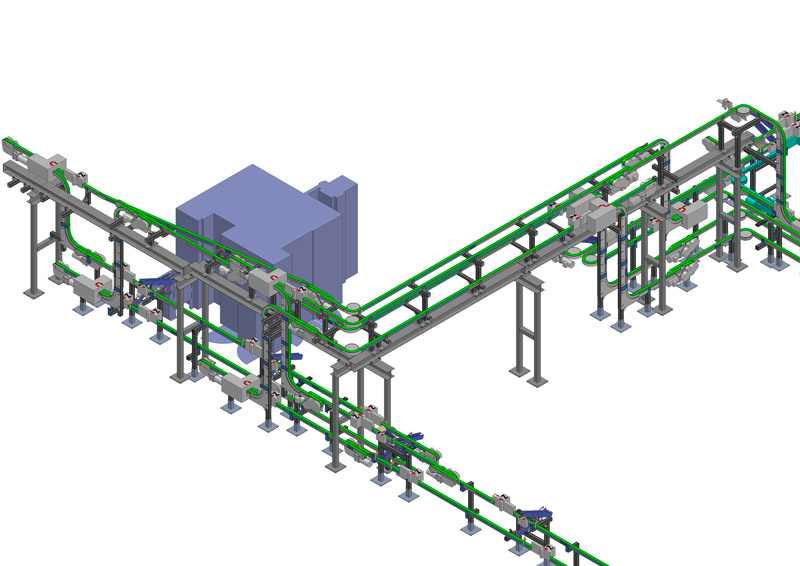
Several processing machines, which are responsible for individual work processes, are linked together by means of a link chain system.

Functional sequence:

The raw and transport parts are gently supplied via the interlinking belt of a processing machine. Integrated compact diverters enable flexible distribution of the transported parts. Once the work process is complete, the component is transported to the next station via our interlinking system.

Variants:

Plastic chains are generally used. As the chains can be exposed to large quantities of steel parts when stored, we also offer plastic chains with special steel fittings. This enables us to prevent the chains from wearing out. Another option offered by this linking system is to transport the parts at different heights. Plastic chains with cycle lifters are used for this. This variant is designed, for example, for production halls that rely on space-saving designs.

Option:

It is also possible to integrate detection stations using camera technology or optical sensors such as light barriers and length sensors. We can also offer you the system as a vertical conveyor.

Our palletizing system enables the stacking and loading of all commercially available containers (KLT, wash baskets, etc.) using servo axes or robots.

Functional sequence:

A stack of empty containers is manually placed in a loading or unloading station. A robot or a lifting/clamping system separates a container and places it in a loading station where it is fixed. The containers are loaded by a robot, a handling system or by the customer! Filled containers are stacked again in another station by a robot or a lifting/clamping system and removed there by the customer.

Variants:

Our palletizing system is available in various types and designs. The most common variant is a robot-supported loading and palletizing cell, in which the insertion of workpieces into the containers is integrated. A linear palletizing system and a swivel palletizing system are also available.

Option:

The system can be adapted to almost all customer container sizes and requirements.

Our pallet transport system links several processing machines that are responsible for individual work processes.

Functional sequence:

The components are gently placed on workpiece carriers via the pallet conveyor at defined transfer points for parts handling. Integrated compact diverters enable flexible distribution of the transported workpiece carriers. Once the work process is complete, the component is transported to the next station via our pallet conveyor.

Variants:

The curves and switches installed in the system differ depending on the size of the workpiece carrier. As standard, we offer our pallet conveyor in the dimensions R150 and R225.

Option:

To increase flexibility, the workpiece carriers can be equipped with a data carrier. This turns an interlinking system into an information flow system that can be used to trace the workpiece data.

Together to the desired product

Really thorough

Do you need a solution that doesn’t yet exist?

We work with you to plan your ideal system for your industry

From the first contact to the handover of the turnkey system, our experienced team of engineers, designers and fitters are on hand to provide you with help and advice. Ask us – we will be happy to advise you!